
o-o

Steven D. Levitt & Stephen J. Dubner
Hay una historia, "El anillo de Giges", que Feldman relata en ocasiones a sus amigos economistas. Procede de La República, de Platón. Un estudiante llamado Glaucón narró la historia en respuesta a una lección de Sócrates, quien, al igual que Adam Smith, defendía que la gente es generalmente buena aun sin imposición. Glaucón, al igual que los amigos economistas de Feldman, discrepaba. Habló de un pastor llamado Giges que encontró una caverna secreta dentro de la cual había un cadáver que llevaba un anillo. Cuando Giges se puso el anillo, descubrió que éste lo volvía invisible. Sin nadie capaz de controlar su comportamiento, Giges procedió a cometer actos deplorables: seducir a la reina, asesinar al rey, etc. La historia de Glaucón planteaba una cuestión moral: ¿podría un hombre resistirse a la tentación del mal si supiese que sus actos no tendrían testigos? Glaucón parecía pensar que la respuesta era no. Pero Paul Feldman se pone del lado de Sócrates y Adam Smith, porque sabe que la respuesta, al menos en el 87% de los casos, es sí.
Falacias lógicas
Cuernos
Vaticinio: Transgénero (kiplingo)
trans·gen·der [trans-jen-der, tranz‑]
–noun
| 1. | a person appearing or attempting to be a member of the opposite sex, as a transsexual or habitual cross-dresser. |
–adjective Also, trans·gen·dered.
| 2. | being, pertaining to, or characteristic of a transgender or transgenders: the transgender movement. |
[Origin: 1990–95 ]
]
]
.//gender c.1300, from O.Fr. gendre, from stem of L. genus (gen. generis) "kind, sort, gender," also "sex" (see genus); used to translate from Gk. Aristotle's grammatical term genos. As sex took on erotic qualities in 20c., gender came to be used for "sex of a human being," often in feminist writing with reference to social attributes as much as biological qualities; this sense first attested 1963. Gender-bender is first attested 1980, with reference to pop star David Bowie. //.
Papel, Vidrio

The Prospect/FP Global public intellectuals poll
Lo mejor es que ignoro a:
Václav Havel
Paul Krugman
Amartya Sen
Jared Diamond
Shirin Ebadi
Bjørn Lomborg
Abdolkarim Soroush
Thomas Friedman
Eric Hobsbawm
Jean Baudrillard
Slavoj Zizek
Freeman Dyson
Jeffrey Sachs
Samuel Huntington
Ali al-Sistani
EO Wilson
Bernard Lewis
Fareed Zakaria
Michael Ignatieff
Chinua Achebe
Anthony Giddens
Lawrence Lessig
Jagdish Bhagwati
Steven Weinberg
Germaine Greer
Antonio Negri
Rem Koolhaas
Timothy Garton Ash
Martha Nussbaum
Clifford Geertz
Yusuf al-Qaradawi
Henry Louis Gates Jr.
Tariq Ramadan
Larry Summers
Hans Küng
Robert Kagan
Paul Kennedy
Daniel Kahneman
Sari Nusseibeh
Wole Soyinka
Kemal Dervis
Michael Walzer
Howard Gardner
James Lovelock
Ali Mazrui
Craig Venter
Martin Rees
James Q Wilson
Robert Putnam
Sergei Karaganov
Sunita Narain
Fan Gang
Florence Wambugu
Gilles Kepel
Ha Jin
Neil Gershenfeld
Paul Ekman
Jaron Lanier
Gordon Conway
Pavol Demes
Elain Scarry
Robert Cooper
Harold Barnus
Pramoedya Ananta Toer
Zheng Bijian
Kenichi Ohmae
Wang Jisi
Kishore Mahbubani
Shintaro Ishihara
Howard Zinn
Cornell West
Gore Vidal
Mohammad Khatami
John Ralston Saul
George Monbiot
Judith Butler
Victor Davis Hanson
The People Who Shape Our World - TIME 100
Hombres
Affirm
1330, from O.Fr. afermer, from L. affirmare "to make steady, strengthen, corroborate," from ad- "to" + firmare "strengthen, make firm," from firmus "strong" (see firm (adj.)). Spelling refashioned 16c. on L. model. Affirmation in law, the Quaker alternative to oath-taking, is attested from 1695. Affirmative "answering yes" is from c,1400, from use in logic; affirmative action "positive effort by employers to prevent discrimination against minority groups in hiring or promotion" is from 1935; now often used more generally for policies such as hiring quotas.
Victoria de Samotracia
Color

Index of Economic Freedom
I.N.E.
Una base de datos adscrita al Ministerio de la Verdad, búsqueda al azar:
Estadística de lo Penal, España, 2005. Condenados por delitos contra la libertad e indemnidad sexuales.
| Europa | América | Africa | Asia | Oceania | ||||||||||
| Varón | Mujer | N.C. | Varón | Mujer | N.C. | Varón | Mujer | N.C. | Varón | Mujer | N.C. | Varón | Mujer | |
| 58 | 10 | 4 | 97 | 6 | 1 | 84 | 0 | 3 | 10 | 0 | 0 | 0 | 0 | |
Plus: Mapa de Distribución de Apellidos
Multiculturalismo


Dictadores
Godwin's Law: As an online discussion grows longer, the probability of a comparison involving Nazis or Hitler approaches one.
George Orwell, 1.946: The word Fascism has now no meaning except in so far as it signifies ‘something not desirable’. The words democracy, socialism, freedom, patriotic, realistic, justice have each of them several different meanings which cannot be reconciled with one another.
Mafalda
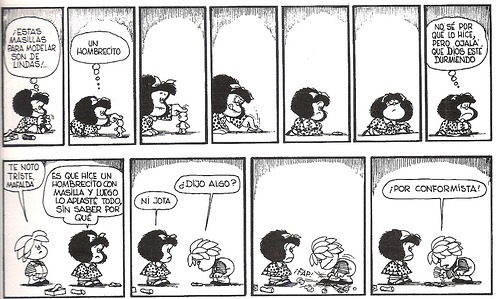
Versiones (!)
Can you blame the repressed for the actions of the repressor? Can you blame the violated for the actions of the violator?
Shackled and emaciated, ! pleads for peace from his deadbed

Bull.shit
[Oxford Advanced Learner's Dictionary]
- noun [U] (slang) (also informal bull) (abbr. BS) nonsense: That's just bullshit.
- verb (-tt-) (slang) to say things that are not true, especially in order to deceive sb: [V] She's just bullshitting [VN] Don't try to bullshit me!
- bull.shit.ter noun
*
Ladies, on whom my attentions have waited
If you consider my merits are small
Etiolated, alembicated,
Orotund, tasteless, fantastical,
Monotonous, crotchety, constipated,
Impotent galamatias
Affected, possibly imitated,
For Christ's sake stick it up your ass.
T.S. Eliot
Addenda: ¿Camama? Jamais entendu parler.
[Diccionario de la Lengua Española]
1. f. vulg. Embuste, falsedad, burla.
Si me preguntan a mí, no convence.
Jill Greenberg


¿Qué querías, un mentiroso o un amante?

Tú no eres ninguna de las dos cosas, ¡fuera, mendigo, fuera! Pero te estás haciendo viejo, chico; la próxima vez no enseñes tus cartas.